Hiring hundreds of bogosorts to help me calculate pi

Happy Pi Day! This fine morning I woke up and felt the sudden urge to torture my CPU.
And what better way to do that than run hundreds of instances of one of the most notoriously inefficient sorting algorithms at once?
Of course the algorithm I speak of is…
Bogosort
In the world of sorting algorithms, bogosort is kind of the laughingstock of the town. The village idiot. He’s just…not that bright. How does it work?
Take a list of size \(n\) and randomly shuffle it until it’s sorted purely by chance.
Yeah, like I said, not too clever of an algorithm. Though, technically it is a way to sort a list.
Love it or hate it, this bad boy can sort a list in a quite frankly impressive \(n!\) shuffles on average.
Recall the factorial of \(n\), written as \(n!\), is the simple product \(n (n-1) (n-2) \cdots (2) (1)\). The reason we can expect bogosort to do its job in \(n!\) shuffles is the same reason a list can be organised in \(n!\) ways. We wouldn’t expect bogosort to need to perform more or less than the total possible number of ways to arrange the items in the list, within a reasonable margin of good/back luck of course. Of course, if you have really bad luck, there is no upper bound on the runtime of bogosort, but let’s pretend that’s not a thing.
For the nerds, since a shuffle requires \(n\) moves, and we need \(n!\) of these, bogosort’s time complexity is an eye-watering \(\mathcal{O}(n \cdot n!)\). So yeah, it’s impressive in the same way one might be impressed with a monkey on a typewriter producing a page of Shakespeare. It’s cool that it can happen, but you’re probably not going to stick around to see it for yourself.
All this yapping and we’re not any closer to seeing what any of this has to do with pi, are we? Fine, let me cut to the chase and introduce today’s weapon of choice.
Stirling’s Approximation
Here it is:
\[n! \sim \sqrt{2 \pi n} \left( \frac{n}{e} \right)^n\]You might be able to guess we can obtain \(\pi\) as long as we have access to \(n\) and \(n!\), but let’s not get ahead of ourselves. Do you think I’m in the mood to calculate \(n!\) like a chump? No, that’s what bogosort is for.
But before we get to that, we should unpack Stirling’s approximation.
First, let’s look at that squiggly little guy (\(\sim\)). In this case, we use this to denote that the two sides are asymptotically equivalent: essentially as \(n\) grows arbitrarily large, the right-hand side becomes a better and better approximation for the left. So just think for large \(n\), we can think of \(\sim\) as \(\approx\). (for legal reasons, I do not condone this abuse of notation and am not responsible for any miscalculations that may occur).
Why on earth does this formula work?
Before we go any further, it might be nice to wave a few hands and run a few sanity checks to convince ourselves this Stirling guy wasn’t some kind of fraud. I’m not going to try and fumble my way through a full proof, but want to at least see if I can convince you that this is reasonable enough to believe.
First, let’s look at the natural logarithm of \(n!\) so we can work with a sum of terms, rather than a product. Smarter people than me say this is a decent play, so I won’t question it.
\[\begin{align*} \ln(n!) &= \ln(1) + \ln(2) + \dots + \ln{n} \\ &= \sum_{x=1}^{n} \ln{x} \end{align*}\]That should be fairly obvious, but what might not be is the fact that this looks like one of those “introduction to integrals” demonstrations you might have seen in high school. You approximate a curve but slicing it into a bunch of skinny rectangles and calculate the area under the curve to be the sum of the areas of those rectangles, right?
If you don’t believe me, witness proof by shoddy p5.js sketch! You can adjust the slider under the curve to see how the integral approaches the actual area under the curve as we add more and more rectangles.
Well, doesn’t \(\ln(n!)\) look like an approximation of \(\int_1^n \ln{x} dx\) to you? Just rectangles of width \(1\).
Re-familiarising myself with some of the most boring calculus I forgot, we can solve this integral using integration by parts:
\[\begin{align*} \sum_{x=1}^{n} \ln{x} &\approx \int_{1}^{n} \ln{x} \, dx \\ &= \Big[ x \ln{x} - x \Big]_{1}^{n} \\ &= n \ln{n} - n + 1 \end{align*}\]If we exponentiate both sides to undo our logarithm, we get
\[\begin{align*} n! &\approx \exp\left(n \ln{n} - n + 1\right) \\ &= \exp\left(n \ln{n}\right) \cdot \exp\left(-n\right) \cdot \exp\left(1\right) \\ &= n^n \cdot e^{-n} \cdot e \\ &= e \cdot \left( \frac{n}{e} \right)^n \end{align*}\]Look at that! We are already remarkably close to Stirling’s actual formula. The only difference is that we have a factor of \(e\) in front of the \(\left( \frac{n}{e} \right)^n\) term, whereas Stirling’s formula has \(\sqrt{2 \pi n}\) instead.
But if we observe that \(\sqrt{2 \pi} \approx 2.507 \approx e\), we see our calculation is accurate up to a factor of \(\sqrt{n}\) which isn’t bad considering we just approximated a sum with an integral.
So hopefully that’s enough to let us move on with confidence that Stirling’s approximation will give us the horsepower for what we want to do. Speaking of which, let’s get to the good stuff.
Where does the \(\pi\) come from?
Let’s just forget I totally hand-waved the \(\pi\) out of Stirling’s formula in my crude explanation above. It’s really there, but it’s quite tricky to derive it. In fact, Stirling didn’t even come up with the idea for his formula, but he did identify the correct constant to put in front of the \(\left( \frac{n}{e} \right)^n\) term was indeed \(\sqrt{2 \pi n}\). The asymptotic formula was originally discovered by De Moivre.
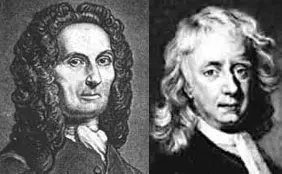
The boys, from left to right: Abraham de Moivre and James Stirling
To give a very rough idea of how \(\pi\) snaked its way into this formula, we can thank how the Gamma function connects factorials to integrals.
\[n! = \Gamma(n+1) = \int_0^\infty t^n e^{-t} dt\]It turns out, when you make this connection and continue to solve the integral using some clever observations about logarithms and Taylor series, you’ll find \(\pi\) emerge in the final steps of the proof. If you’re interested in the details, I’d recommend checking out this question on Math Stack Exchange.
All this hand waving, and suddenly \(\pi\) emerges!
Now, let’s just dust off some high school algebra and isolate \(\pi\), and I’ll use the \(\approx\) sign here because we can assume we are talking about a sufficiently large \(n\) (what constitutes “sufficiently large” in this case? i’ll let you decide).
\[\begin{align*} \sqrt{2 \pi n} \left( \frac{n}{e} \right)^n &\approx n!\\ \sqrt{2 \pi n} &\approx n! \left( \frac{e}{n} \right)^n\\ 2 \pi n &\approx n!^2 \left( \frac{e}{n} \right)^{2n}\\ \pi &\approx \frac{n!^2}{2n} \left( \frac{e}{n} \right)^{2n} \end{align*}\]Here’s what itches the whip-cracking part of my brain: I’m far too lazy to calculate \(n!\) directly, so I’ll just coerce my CPU into fetching it for me, and then I’ll use that value to estimate \(\pi\).

Exercising free will by obtaining \(n!\) empirically, for some reason
Here is where the dunce up my sleeve, bogosort, gets to shine.
As previously discussed, the number of shuffles expected for bogosort to sort a list is \(n!\), which means we get a way of counting \(n!\) without having to do the computation ourselves.
Instead, we will employ hundreds of bogosort algorithms to sort hundreds of lists, until we are satisfied with our average, our approximation for \(n!\).
Why would we do that when instead we could just calculate directly \(n (n-1) \cdots (2) (1)\)? It’s a free country, I can make my CPU do whatever I want!
Anyways, suppose we do this, and obtain an average number of shuffles for a list of size \(n\). We’ll call this \(S\).
Plugging our hard-earned \(S\) back into our beautiful, Frankensteinian equation, we get our official Bogosort-\(\pi\) estimator:
\[\pi \approx \frac{S^2}{2n} \left( \frac{e}{n} \right)^{2n}\]The plan is as follows: pick a huge \(n\), run bogosort millions of times to get a rock-solid average \(S\) and calculate \(\pi\) to a glorious number of decimal places just in time to celebrate March 14, I wonder what Matt Parker’s up to this year….
And obviously the accuracy of our result relies on choosing a sufficiently large \(n\) to satisfy the gods of asymptotic analysis.
Nothing could possibly be wrong with this plan. Ever. Nope.
…wait. The larger \(n\) is, the longer bogosort will take to complete.
At what turns out to be a worse-than-exponential rate.
Competing objectives

Thanks to that eye-watering \(\mathcal{O}(n \cdot n!)\) time complexity, choosing an appropriate \(n\) could mean the difference between our CPU finishing the task in a reasonable amount of time, and it dwarfing the age of the universe.
To put things into perspective, let’s choose a modest \(n := 20\) for our experiment. The expected number of swaps required to sort this once with our good friend bogosort is on the order of \(20 \cdot 20!\), which comes out to 40 quintillion, or 40 billion billion (fun fact: this is roughly the number of configurations of the Rubik’s cube). Let’s be generous and suppose our CPU can perform 40 billion swaps per second (my best attempt at benchmarking this on a Ryzen 7 9700X was about 4 billion swaps per second, but let’s be optimistic). This means that we’d be looking at 1 billion seconds, or 32 years, to sort a single list. And that’s assuming we get the average case scenario, which is completely at the mercy of the random number generator. Wait, would it be easier if I just call it a day and schedule this post for Pi Day 2058?
No, let’s see what happens if we choose \(n := 10\) instead. Remember when I said \(n\) should be “sufficiently large”? If you ask me, 10 is pretty up there. Definitely one of the bigger numbers I’ve seen. Anyway, let’s roll with it. No further questions.
Since \(10 \cdot 10!\) is only about 36 million, I like our chances of getting this one done in time. In fact, we can even run it over and over again comfortably to get a good average for our \(S \approx 10!\). I like this as a testament to the growth of the factorial function, how dramatically different the output is from just \(n := 10\) to \(n := 20\).
In fact, go ahead and try changing the value of \(n\) in the interactive visualisation below. You might have even thought the sketch was broken at first glance, because 90% of the bars look like they’re straight up missing.
But no, they’re just that small compared to the last two bars, representing \(19!\) and \(20!\).
The plan?
Anyway, I believe I’m yapping again. Let’s summarise the plan for approximating \(10!\) and then using that to estimate \(\pi\):
Set \(S := 0\) and repeat the following \(K\) times (where \(K\) is as many as you have the patience for):
- run bogosort on a list of size 10, keeping track of the number of shuffles required, let’s call this \(s\);
- increment \(S\) by \(s / K\), as to contribute to our running average.
If you prefer, we can write this in concrete C code. This is exactly how I implemented it, and my \(K\) was 320 which is obtained by multiplying my number of CPU cores (16) by the number of trials I wanted to run on each core (20). I parallelised the code to squeeze as much bogosort out of my CPU as I could. Here’s a visualisation of the process (for reference, \(10! = 3,628,800\)):
But for the sake of simplicity, here is a single-threaded version of the code:
#include <stdio.h>
#include <math.h>

#define N 10
#define K 320

int main() {
    long long total_shuffles = 0;

    for (int t = 0; t < K; t++) {
        int arr[N] = {4, 2, 9, 1, 5, 3, 8, 6, 10, 7};

        long long s = 0;
        while (!is_sorted(arr, N)) {
            shuffle(arr, N);
            s++;
        }
        total_shuffles += s;
        printf("Trial %d completed. Shuffles: %lld\n", t, s);
    }

    // Calculate our empirical average
    double S = (double)total_shuffles / K;

    // Calculate Pi using our Bogosort-derived S
    double e = exp(1.0);
    double pi = (S * S) / (2 * N) * pow(e / N, 2 * N);

    printf("Empirical S (Average shuffles): %f\n", S);
    printf("Estimated value of pi: %f\n", pi);

    return 0;
}
The moment of truth
Running the above C code, and depending on your luck…
$ gcc main.c -o bogopi -lm
$ ./bogopi

Trial 0 completed. Shuffles: 1677134
Trial 1 completed. Shuffles: 7093752
Trial 2 completed. Shuffles: 708255
Trial 3 completed. Shuffles: 1584920
...
Trial 318 completed. Shuffles: 3490385
Trial 319 completed. Shuffles: 5376543
Empirical S (average shuffles): 3611139.253125
Estimated value of pi: 3.163356

Hey, that’s pretty good! Especially considering our bogosorts did their job on average in 3,611,139 shuffles, and we know the real \(10!\) is 3,628,800. Being within 0.49% of the true factorial is a fantastic result.
So now we can all go home and rest easy knowing that \(\pi \approx 3.163356\) according to the consensus of 320 bogosorts… right?
Fun fact, here’s an interpretation of a circle if \(\pi = 3.163356\). I’m choosing to use \(L^p\) space to define our geometry. Read more about it and play with the slider to see other “circles” (squircles?)
The ceiling
Wait a minute.
Suppose, just for a moment, that our bogosort was perfect. Suppose it wasn’t subject to the whims of a random number generator, and it gave us the exact, mathematically precise value for \(10!\), with zero error. What would happen?
Well, even with a perfect \(n!\), Stirling’s approximation is still only an approximation. It converges to the true value as \(n \to \infty\), but \(n = 10\) is decidedly not infinity. In fact, if we plug the exact value of \(10! = 3{,}628{,}800\) into our formula, we get:
\[\pi \approx \frac{3628800^2}{2 \cdot 10} \left( \frac{e}{10} \right)^{20} = 3.1944\dots\]That’s 1.68% above the true \(\pi = 3.14159\dots\), and there’s absolutely nothing we can do about it. No amount of bogosort trials will fix this. It’s baked into the formula itself.
This 1.68% is the theoretical floor on our error at \(n = 10\). For larger \(n\), Stirling’s approximation gets better: at \(n = 50\) the floor drops to 0.33%, and at \(n = 100\) it’s 0.17%. But as we’ve already established, we can’t use large \(n\) because bogosort won’t finish before the heat death of the universe.
Error propagation a.k.a. \(S^2\) does us a solid
To make matters worse, notice that our formula squares the bogosort average (\(S\)):
\[\pi \approx \frac{S^2}{2n} \left( \frac{e}{n} \right)^{2n}\]By the standard rules of error propagation, when a measured quantity is squared, the relative error in the result is doubled.
So if bogosort underestimates \(10!\) by 0.5%, our \(\pi\) estimate shifts by about 1.0%. This means any empirical noise we generate is amplified on top of the 1.68% theoretical floor we are already stuck with.
This could work in our favour, however, if bogosort underestimates. In that case, it would actually be nudging our estimate closer to the true value of \(\pi\), potentially cancelling out Stirling’s floor.

It’s time for me to come clean
It’s time for me to confess: the only way to get a "good" estimate of \(\pi\) using this method is to be actively, deliberately lucky. But not too lucky! Let me explain.
Because Stirling’s formula has a built-in overestimate for \(\pi\), we actually want our bogosort trials to finish early. We need them to hit the sorted array faster than they mathematically should, artificially cutting our \(S\) value down just enough so that when it gets squared, it drags Stirling’s approximation for \(\pi\) back down enough to look like the whole system works.
In my case, I simply kept running the experiment with \(n := 10\) and \(K := 320\) until I saw a result I was happy with.
The average of many runs will eventually land our \(S\)-value close to the true \(10!\) (which ironically, ruins our \(\pi\) estimate by pushing it back up to 3.19). But any single attempt of 320 trials is a complete roll of the dice. You are entirely at the mercy of RNG.
The verdict
So, is this a good way to calculate \(\pi\)? Just kidding, I know nobody is still reading and asking that question. But for the record, here’s a summary of everything working against us:
- Stirling’s approximation needs a large \(n\) to be accurate, but bogosort needs a small \(n\) to actually, you know, complete in time for Pi Day.
- At \(n = 10\), Stirling’s formula has a built-in 1.68% overestimate that no amount of trials can fix.
- The squaring of \(S\) doubles any empirical noise.
- The only way to accidentally land near the true \(\pi\) is if our bogosort gets slightly unlucky at estimating \(n!\) (but not too much!) to cancel Stirling’s bias.
We are using one of the worst possible sorting algorithms to fuel an asymptotic approximation at values where it is not yet asymptotic, and the only path to a correct answer is through a lucky coincidence of offsetting errors.
Even so, the fact that 320 instances of an algorithm that sorts by pure random chance can even semi-consistently produce a number that starts with the digit \(3\) should be celebrated. Happy Pi Day!